
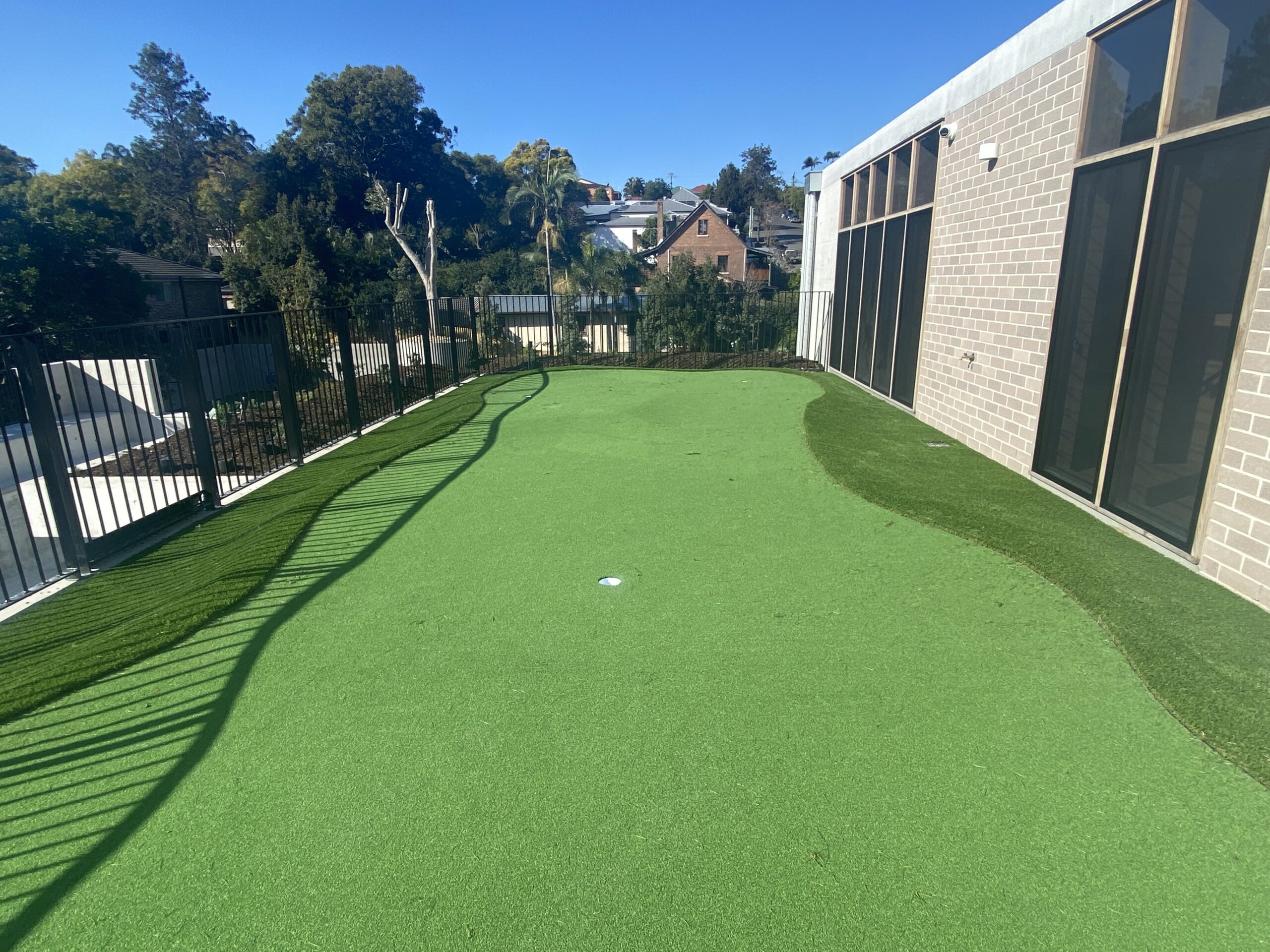
Main Introduction
Putting Greens in the Northwest Houston Estate Market
Synthetic putting green design and installation in the Cypress corridor has a natural client base in the estate properties of Stable Gate, Sterling Knoll, Bridgeland's larger lot phases, Black Horse Ranch, and the custom home sections along FM 529 and FM 2920 where backyards have the space to accommodate multi-hole practice layouts. The northwest Houston estate market produces serious golf households — people who play regularly, practice with intention, and want a backyard green that performs consistently rather than a decorative feature that looks like a golf green but does not play like one.
Turf Installation of Cypress approaches synthetic putting green projects with the design-first discipline that makes the difference between a functional practice installation and a surface that looks right at first but frustrates golfers within a season. That means contour planning before material is ordered, base compaction calibrated to ball roll requirements, cup placement documented in a layout that produces playable break angles, and fringe and chipping zone specifications that integrate with the green surface in a way that serves actual practice patterns.
The northwest Houston summer climate — extreme heat from May through September, high humidity, and occasional strong wind events — means outdoor putting green installations here need turf systems with UV stability, heat-tolerant backing, and pile characteristics that do not mat down or lose consistency under sustained high temperature. Material selection for Cypress-area putting green projects accounts for these climate realities rather than using turf systems designed for more temperate environments.
Design Phase: Contour, Cup Placement, and Layout Planning
A synthetic putting green project begins with design, not material selection. Design decisions determine whether the finished green provides interesting and realistic practice or serves as a flat, featureless surface that golfers stop using within a few months.
Contour design for a residential putting green in the northwest Houston market has to balance two competing requirements: producing break angles that are interesting and trainable, and staying within the topographic constraints of the backyard space. A steep contour on a 400 square foot backyard green is not functional — it creates impossible putts, not practice scenarios. A flat green on a 1,200 square foot estate yard installation is a missed opportunity.
Turf Installation of Cypress approaches contour design by first measuring the available space, then working with the property owner to define the intended practice goals — approach putt distance, break complexity, chipping zone requirements, and cup count. From that conversation, a layout plan is produced that documents contour placement, cup locations, fringe boundaries, and any chipping zone specifications. This layout becomes the governing document for base shaping, turf cutting, and cup installation — not a rough sketch that gets interpreted differently by each crew member.
Cup placement drives the contour design in practice. Cups are placed to create at least two distinct break angles from the fringe edge — enough variation to make every session different. For larger estate green installations, cup count and placement are reviewed relative to the number of distinct zones the layout creates, so play can rotate through genuinely different challenge scenarios.
Base Preparation: Where Ball Roll Is Determined
The single largest influence on putting green ball roll performance is base preparation, not turf pile height. A putting green turf installed on an inadequate base will produce inconsistent roll, visible dips after the first wet season, and surface grade that fights the intended contour. The base is what the golfer is actually putting on — the turf is just the surface interface.
For northwest Houston putting green installations, base preparation begins with removal of existing soil to a depth appropriate for the intended base system. In the Cypress clay environment, that typically means removing organic and clay material to a minimum depth that allows for a stable, well-draining crushed granite or decomposed granite base. Clay cannot serve as a putting green subbase — it shrinks, expands, and moves in ways that undermine any surface contour placed on top of it.
Crushed granite base material is compacted in layers, not in a single application. Each layer is compacted to a firm, uniform standard before the next is added. The final surface is graded to match the intended contour layout documented in the design phase. Contour precision at this stage directly determines the consistency of ball roll across the finished green — variations of even a quarter inch in the base grade translate to inconsistent surface behavior under the low-pile turf.
Turf Selection for Northwest Houston Putting Greens
Putting green turf systems differ significantly from residential lawn turf. Pile heights for functional putting greens range from 0.3 to 0.5 inches depending on intended roll speed — shorter pile for faster, more tournament-style greens, slightly longer for more forgiving practice speeds. Blade architecture is designed for minimal resistance to ball roll rather than the upright resilience preferred for decorative lawn applications.
Backing systems for putting green turf installed in the northwest Houston climate need UV stability appropriate for sustained extreme heat exposure. Systems not rated for this climate can show backing degradation within three to four years, creating a surface that develops inconsistent bounce and eventually requires complete replacement.
Infill selection for putting greens is minimal compared to other turf applications — typically silica sand at a controlled depth to provide slight cushioning without impeding ball roll. Over-infilling a putting green surface slows ball roll unpredictably and changes the surface feel in ways that make practice non-transferable to actual course conditions.
Fringe and Chipping Zones
A putting green without a properly specified fringe zone is an incomplete installation for anyone who plans to use it for short game practice. Fringe turf is a different specification than green surface turf — longer pile, different blade architecture, and a clear visual and tactile border that defines the edge of the putting surface. Fringe placement determines where chip approaches land, how ball roll transitions from rough to green speed, and how the overall layout appears from the residence and entertainment areas adjacent to the green.
Chipping zones adjacent to putting green installations extend the practice value significantly. A chipping zone area of 200-400 square feet of higher-pile turf placed at a defined distance from the green edge — with targets on the green set at realistic chip distances — allows full short game practice from chip shots through final putts. Chipping zone turf specification uses a different pile height and infill level than the green surface itself, and edge transitions between zones are finished cleanly.
Putting Green Installations Across the Northwest Houston Corridor
Synthetic putting green projects are completed throughout the northwest Houston service area: Cypress, Jersey Village, Tomball, Spring, Hockley, Waller, Katy, Brookshire, Pinehurst, Magnolia, Hempstead, Prairie View, and Northwest Houston. Estate lot properties in the Stable Gate and Sterling Knoll sections of Cypress, larger lot custom homes in Katy's Cinco Ranch premium sections, and ranch estate properties in the Hockley FM 362 corridor all represent the primary residential putting green market for this region.
What Is Included
- Design-first approach: contour and cup placement before any installation
- Compacted granite base at depth appropriate for clay excavation
- Contour shaping matched to documented layout spec
- UV-stable, heat-rated backing for Houston climate
- Cup placement producing varied break angles for training utility
- Fringe turf specification separate from green surface
- Chipping zone integration for extended short game practice
- Residential estate and ranch acreage lot putting green experience
Process Steps
- 1Space measurement and practice goal assessment
- 2Contour design: break angle planning, cup placement, fringe and chipping zone layout
- 3Layout documentation: governing spec for base shaping and turf cutting
- 4Clay removal and base excavation to design depth
- 5Crushed granite base installation in compacted layers
- 6Final grade to match contour layout specification
- 7Low-pile putting surface turf placement and cup installation
- 8Fringe turf placement, edge finishing, and roll-speed verification
Use Cases and Applications
- Multi-hole backyard putting green on Cypress estate lots
- Sterling Knoll and Stable Gate residential estate putting green installations
- Hockley and Katy ranch property putting green on acreage
- Putting green with adjacent chipping zone for full short game practice
- Commercial putting green for hospitality or entertainment venues
- Compact single-cup backyard practice green on standard residential lots
- Multi-cup layout with fringe and rough zones for tournament-style practice
- Putting green integrated into outdoor living and entertainment yard design
Why Property Owners Choose This Service
- Contour design documented before material is ordered
- Cup placement creating multiple break angles and play scenarios
- Crushed granite base compacted in layers to contour specification
- UV-stable turf systems rated for northwest Houston extreme heat
- Pile height and infill selection calibrated for ball roll performance
- Fringe zone specification with clear turf and pile transition
- Chipping zone integration for full short game practice layout
- Coverage across Cypress estate lots and northwest Houston ranch acreage
Pricing Factors
- Project size and access conditions.
- Base preparation and drainage requirements.
- Material specifications selected for expected usage.
- Edge details and transition complexity.
- Scheduling constraints and phased execution needs.
Service Area Coverage
Related Services
Frequently Asked Questions
How is contour designed for a Cypress estate backyard putting green?
Contour design starts with measuring the available space and defining practice goals — putt distance, break complexity, cup count, chipping zone needs. A layout plan is then produced documenting contour placement, cup locations, and fringe boundaries before any base work begins.
What base preparation is needed for a northwest Houston putting green?
Clay subsoil is excavated to appropriate depth and replaced with compacted crushed granite base installed in layers. Clay cannot serve as a putting green subbase — it moves seasonally in ways that undermine surface contour and consistency.
What pile height should a Cypress residential putting green use?
Pile heights for functional putting greens typically range from 0.3 to 0.5 inches depending on target roll speed. Shorter pile produces faster, more challenging greens; slightly longer pile suits practice-focused installations where forgiveness is preferred.
Can a chipping zone be added to a backyard putting green installation?
Yes. Chipping zones are specified with higher-pile turf at a defined distance from the green edge, with target cup positions set at realistic chip distances. Fringe and chipping zone specifications are reviewed as part of the overall layout design.
How do northwest Houston summer temperatures affect putting green turf performance?
Extreme heat from May through September requires UV-stable turf systems with backing rated for sustained high temperature exposure. Turf systems not designed for this climate degrade at the backing level within three to four years, creating inconsistent surface behavior.
Do you design putting greens for ranch estate lots in Hockley and Waller?
Yes. Ranch estate putting green projects on larger acreage lots in Hockley and Waller receive the same design-first approach, contour documentation, and crushed granite base preparation as estate lot projects in Cypress. Access staging for rural properties with long driveways is reviewed during planning.